
Schedules and recurring work
Create, test, pause, edit, and review recurring AI employee jobs in Yodu with clear owners, timing, run history, and approval controls.
Schedules are for work that should repeat without creating the same task manually each time.
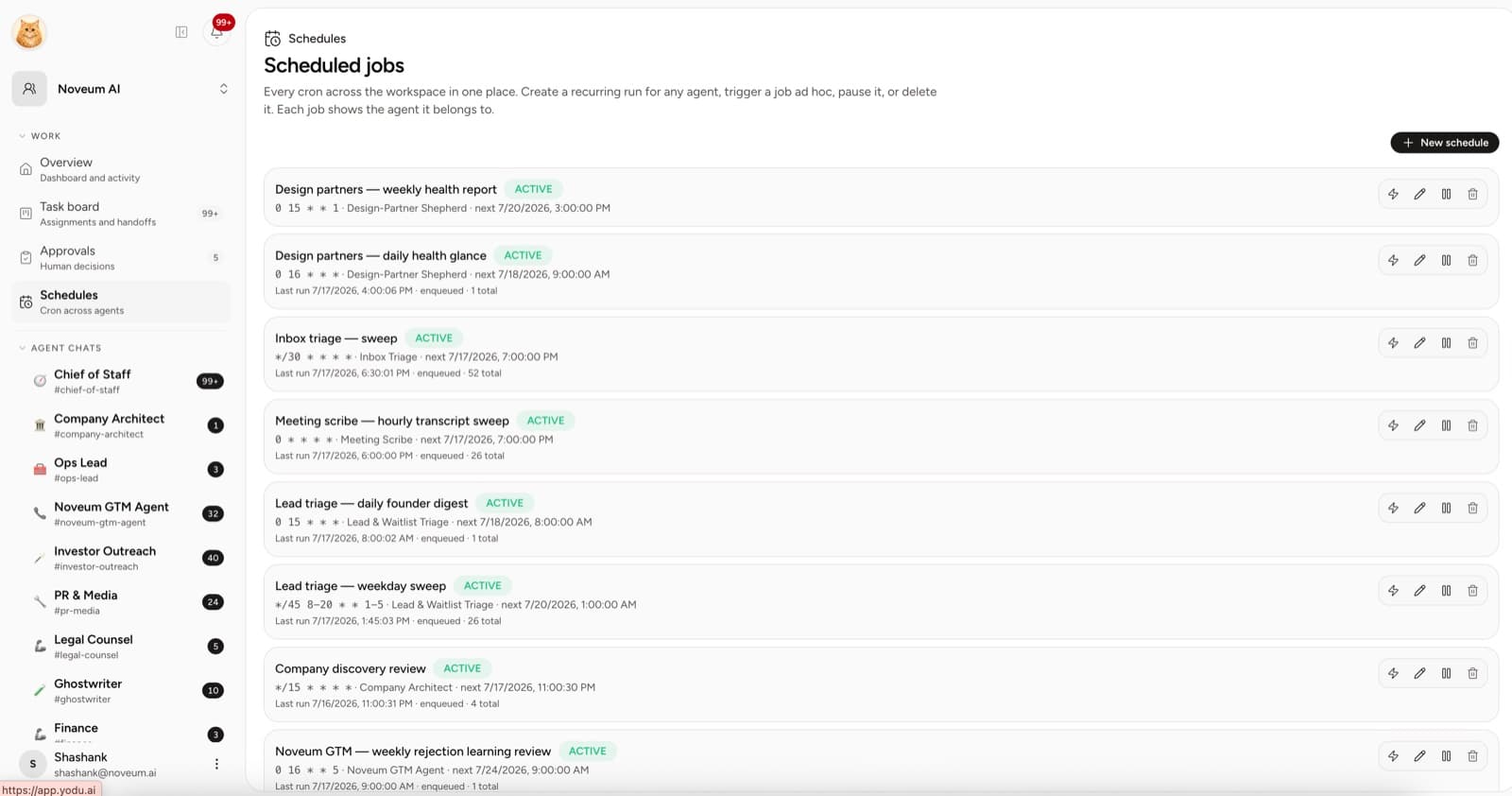
Company discovery schedule
Yodu seeds one system-owned Company discovery review schedule for Company Architect. The deterministic controller adjusts its next run from safe workspace state:
- every 15 minutes during the first 48 hours while canonical company memory is missing or still draft
- every 2 hours afterward while those documents remain incomplete
- every 24 hours after all six canonical documents are active
Each run receives a bounded, redacted inventory of memory metadata, file metadata, active connections, employees, schedules, runtime freshness, and backup/file-sync evidence. Secret values, connection encryption fields, storage object keys, messages, and file or memory bodies are excluded from that snapshot.
Adaptive behavior applies only while the schedule retains its exact system name, description, and Company Architect owner. If you edit those fields, Yodu respects the schedule as an ordinary cron job instead of overriding your cadence.
Create a schedule
Open Schedules and select New. Define:
- a clear job name
- the AI employee owner
- the recurring cadence
- timezone
- the work instruction
- the expected output or destination
Use a name that describes the outcome, such as “Monday competitor brief” or “Daily support theme review.”
Test before relying on it
Use the run control to trigger the job on demand. Confirm:
- the correct employee receives the work
- the employee has the required memory and tool access
- the output appears in the expected place
- sensitive actions still stop at the approval gate
- the last-run information updates
Only then leave the recurring schedule active.
Manage active schedules
Each row shows the owner, cron cadence, previous run, next run, state, and total queued runs. Use the row controls to:
- run now
- edit
- pause or resume
- delete
Pause a schedule before changing the connected account, role policy, or expected output it depends on.
Good recurring jobs
- weekly market or competitor brief
- daily inbox theme summary
- follow-up preparation after new calls
- scheduled pipeline hygiene review
- weekly content opportunity scan
- recurring repository or issue summary
Avoid open-ended schedules such as “grow the company every hour.” A recurring job should have a stable input, a clear output, and an owner who can be reviewed.
Review habit
Review active schedules weekly. Remove obsolete work, adjust cadence when output is noisy, and check that the employee still has the right context and tool access.
Recurring work should reduce coordination. If a schedule creates output no one reviews or uses, pause it and refine the job.
Approvals and autonomy
How Yodu's human-in-the-loop model works — what triggers an approval, the inline chat card and the queue, Allow once / This session / Deny, and how the gate composes with per-employee tool switches.
How the platform runs
An architecture tour of Yodu — the control plane, the managed runtime host, the command queue, per-workspace OpenClaw containers, the sidecar worker, provisioning, and model routing.